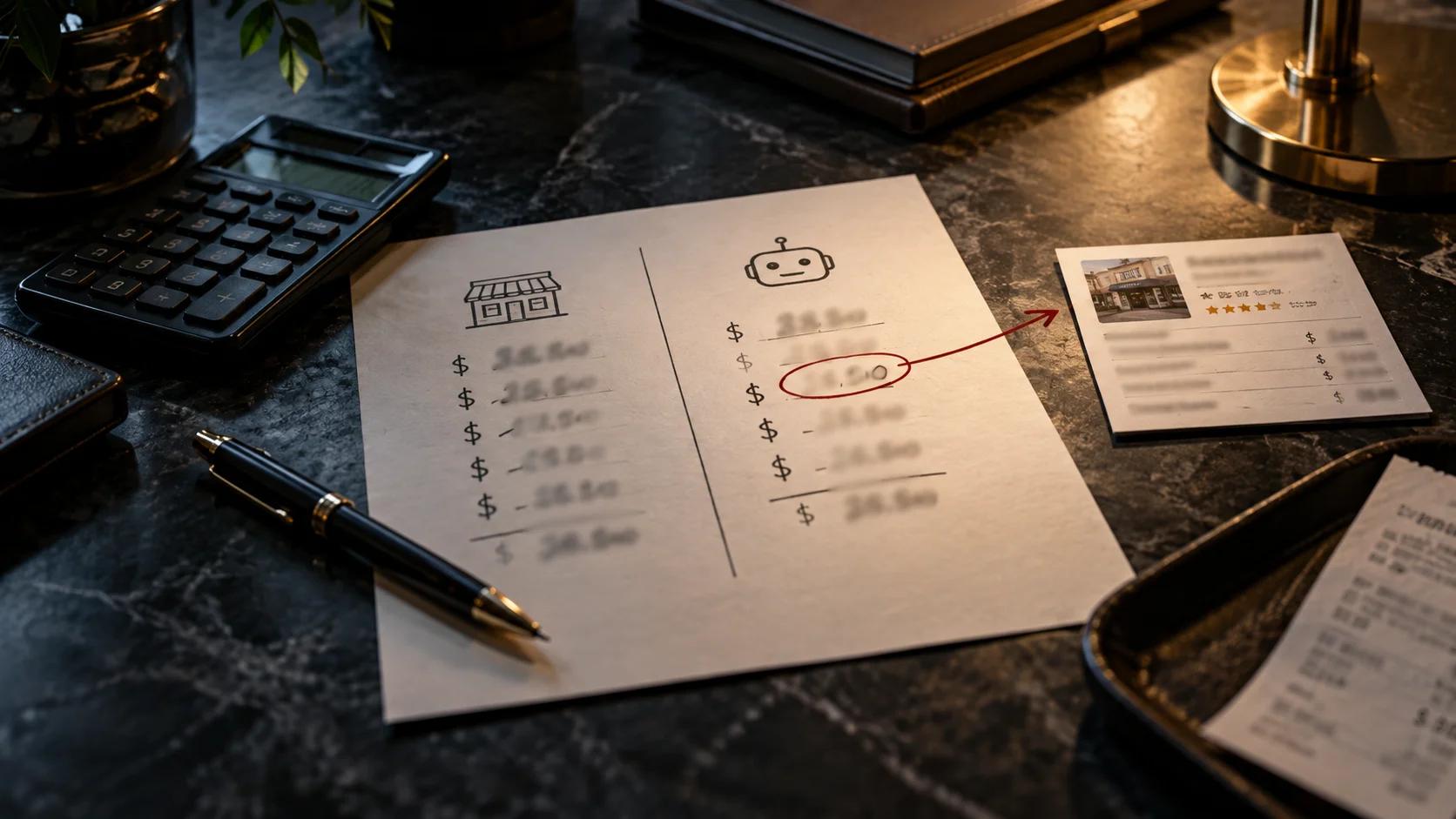



This guide ends in a sheet. On the left you copy the three lines your website uses to say why people should pick you; on the right, three things customers said, exactly as they said them. Put them side by side and the reason your customers keep giving - and your site never mentions - jumps out. That reason goes on your site, and into any tool that makes ads or posts for you, before the tool writes a word.
Filling in the two columns takes about half an hour with your reviews open. Gathering new lines and logging calls takes a couple of weeks. After that, a little time once a month.
One thing before you start: you're not running a customer satisfaction survey. No star ratings, no "how likely are you to recommend us." You want one answer, in your customer's own words: why they went with you instead of the next name on the list.
Why this comes before any tool
A new kind of tool has stopped helping you write ads and started handing you finished ones. You paste in your web address, it reads the site, and it builds the ad.
Here's a real one. On October 1, 2026, Higgsfield launched Ads Studio. It pulls your brand in from your website, and it has a field called "Selling Points," which Higgsfield describes as the main reasons to buy, used to build ad angles.
So think about what lands in that field. If it's filled from your homepage, and your homepage says "quality, experience and personalized care," the tool will build you polished ads about quality, experience and personalized care. Your competitor across town could run the same ads.
What your site says is usually what you believe about why people buy. What your customers say is what actually tipped them. Those two lists don't always line up, and this guide is about catching the difference while you still get to decide which words the tool uses.
Where the real reasons already live
You don't need to invent anything here. Your customers have already told you why they bought, and it's sitting in four places.
1. Your Google reviews, and anywhere else you get reviewed
Go to your Google Business Profile and read your reviews, newest first. Skip past the glowing ones that could be about anybody. You're hunting for lines that name something specific:
- "They texted me the price before they came out" tells you something. "Great service" tells you nothing every other review doesn't.
- "In and out in forty minutes, like they said" tells you something. "Very professional" doesn't.
- "They had an opening after work" tells you something. "Highly recommend" doesn't.
Don't skip the three- and four-star reviews. Those are often the most honest about why someone chose you, because they're also telling you what went wrong, and they picked you anyway.
Short on reviews? Fix that first. The 5-star review system covers how to ask without it getting awkward.
2. Thank-you emails, cards and texts
People loosen up in a private message in a way they never do on Google. You'll find lines like "Two other shops told me I needed a whole new unit. You were the only ones who checked." That kind of line is gold, and it's also private, so read Part 7 before it goes anywhere.
Search your inbox and your texts for "thank you," "finally," "nobody else," "first time." Copy the full sentence, not the gist.
3. The phone
Whoever picks up your phone hears reasons to buy all day long, and they vanish the moment the call ends. "My neighbor said you guys actually show up when you say you will." "You were the only ones open on Saturday." Gone.
For the next two weeks, ask that person to keep a running note of anything a caller says about why they called. Exact words, no cleanup, no names.
4. The moment they say yes
This is the best moment you've got, and the easiest one to let slip by. The customer has just made the decision, so the reason is fresh. One well-placed question gets you the cleanest answer you'll ever collect. Part 3 has the wording.
No summarizing, no "brand voice," no fixing their grammar. "They didn't try to upsell me on stuff I didn't need" is a reason. "Honest, transparent service" is you rewriting that reason into something nobody would say out loud - which is exactly the habit this guide is trying to break.
How to ask why they chose you (without it feeling like a survey)
Surveys announce themselves: a link, a scale, a string of questions. A real question is one question, asked by a person who wants to hear the answer.
Five rules:
- One question, not two. The second one buries the first.
- Don't lead. Ask "Was it the price?" and you'll hear "Yeah, the price." Keep it open and let them answer.
- Then be quiet. Give it three seconds. The good answer usually comes after the pause.
- If they're vague, follow up once. "Your reviews" - "What did you read that sold you?" "The service" - "What stood out?"
- Write it down the same day. Tomorrow you'll remember the gist and lose the words.
At the close, in person or on the phone:
Quick question before we get you on the schedule, just because I'm curious: out of everyone you could've called, what made you pick us?
By text, a day or two after the job:
Hi [name], thanks again for having us out. One quick question, and it really helps: what made you choose us? One line is plenty.
With someone who's been a customer for years:
You've been with us a while, and we don't take that for granted. What keeps you coming back?
When someone thanks you:
That's really good to hear. What made the biggest difference?
For your Spanish-speaking customers:
Al cerrar:
Una pregunta antes de seguir, por pura curiosidad: de todos los que podías llamar, ¿qué te hizo escogernos a nosotros?
Por WhatsApp, uno o dos días después:
Hola, [nombre]. Gracias otra vez por venir. Te hago una sola pregunta, que nos ayuda mucho: ¿qué fue lo que te hizo elegirnos? Con una línea basta.
Con un cliente de hace años:
Llevas tiempo con nosotros y eso no lo damos por hecho. ¿Qué es lo que hace que sigas viniendo?
Cuando un cliente te da las gracias:
Qué bueno saberlo, de verdad. ¿Qué fue lo que más te sirvió?
The two-column sheet, and how to read it
Left column: your website. Pull up your homepage and copy the three lines that explain why someone should pick you. They're usually at the top or in a "Why choose us" section. If you can't find any, write "doesn't say."
Right column: your customers. Three exact quotes from Part 2. Try to pull them from different places: a review, a text, something said on a call.
Line them up and go row by row. Each line lands in one of three places:
| What you see | What it means | What to do |
|---|---|---|
| They match. A line on your site says what a customer said, in roughly the same words | Your site already sounds like your customers on that point | Keep it near the top, say it in both languages, put it in the selling-points field |
| Your site says something no customer said. "Quality," "experience," "personalized care" | It's what any business would say. Not false, just not why anyone picked you | Leave it, but stop leading with it. Move it down and keep it out of the selling-points field |
| Your customers say something your site doesn't. A specific reason that keeps showing up in their words | That's your find. A real reason nobody else is using | Write it on your site - in your voice or quoted with permission - and into the tool's field before you generate |
What a filled-in sheet looks like (example, not a real business):
| What a dental office's website says | What its patients said |
|---|---|
| "Quality care with the latest technology" | "They explained every step before they did it and I never felt rushed" |
| "Years of experience serving you" | "They got me in the same day when I called" |
| "A team committed to your smile" | "They sent the treatment plan in writing so I could check my insurance first" |
Nothing matches. Any dental office could put the left column on its site. The right column has three reasons this site never mentions: explaining before doing, same-day visits, a written plan to check against insurance. Those belong at the top.
If a reason appears in a single review, write it down and keep watching. Once you've seen it in two or three different places, it's a reason.
Putting your customers' words to work
On your website
The first few lines of your homepage, each service page, and your Google Business Profile description. That's what a first-time visitor reads first.
Two ways to write it:
- Their reason, in your voice. A customer said "they called me back the same day." Your site says "We call you back the same day." Their idea, told as something you do, with no quotation marks and no name. You're not quoting anyone, so you don't need permission - as long as it's true, it leaves out health and money details, and nothing in it points to the customer.
- The customer's line, quoted. In quotation marks, word for word, only after you've asked them (Part 7).
Do not polish it until it sounds like ad copy. "They called me back the same day" does not become "prompt, responsive communication." The minute you polish it, you sound like everyone else again.
In any tool that makes pieces for you
The label changes from tool to tool: "selling points," "key benefits," "reasons to buy," "why choose us." Whatever's in that box steers every piece the tool makes.
The rule: fill that field yourself, before you generate, with your customers' reasons.
- Find the field before you hit generate. If the tool already filled it from your website, go through it line by line: keep what matches what your customers say and swap the rest.
- Enter three to five reasons, one per line, in your customers' words. The ones that keep showing up in your right column go first.
- Use the list that matches the language of the piece (Part 6).
- No field like that? Put the reasons at the very top of your request: "Here are the real reasons our customers choose us, in their words: ..." Tuesday's article covers what changed in ChatGPT and Claude.
If you're in a regulated profession (dentist, lawyer, doctor and others), Florida may have its own rules about publishing a patient's or client's words. Before you do, read what your website can't say in Florida. This guide isn't legal advice.
Two languages, two lists
If you do business in English and Spanish, keep two lists. Not one list and its translation: two lists, each built from what customers in that language actually told you.
The right-hand column holds word-for-word lines, and a line said in Spanish and run into English isn't anybody's line anymore. With one list, you can't tell whether customers in the other language say the same thing or something else. With two, you find out.
How to do it:
- Sort your customer quotes by the language they were said in.
- Fill in one two-column sheet per language. The left column comes from your site in that language.
- Making something in English? Use the English list. In Spanish, the Spanish one.
- Short on quotes in one language? Use that language's questions from Part 3 for the next few weeks until you have three.
Privacy and permission
Your customers' words belong to them. Treat them that way:
- No names by default. On your sheet and in a tool's field, the quote goes in without a name.
- No health or money details, ever. If a line mentions a treatment, a diagnosis, what someone owed or paid, cut that part or skip the line.
- No screenshots of texts or messages with a name or number visible.
- Ask before you quote a customer's words, word for word, with their name or without it. Putting the idea in your own words, with no name and no details that point back to them, doesn't need a yes.
To ask:
The way you put that says it better than anything we could write. Would you mind if we used it on our website? It can go up without your name, or with it if you'd like.
For a Spanish-speaking customer:
Lo que me dijiste lo explica mejor que cualquier cosa que escribamos nosotros. ¿Te molesta si lo ponemos en nuestra web? Puede ir sin tu nombre, o con tu nombre si prefieres.
If they say no, the reason is still yours to use - on your sheet, and on your site in your own voice. What you don't do is publish their line anyway. If you're in health care or law, read what your website can't say in Florida before publishing.
Once a month
Reasons drift. You add a service, hire someone new, the season turns. Once a month, same day if you can:
- Collect three new customer quotes from the same four places.
- Add them to the right column, with the date.
- Check whether a new reason keeps coming up, or an old favorite has gone quiet.
- If a new one keeps coming up, add it to your site and to your list for the tools.
After two or three months of notes, you'll know which reasons are really yours: the ones that show up every single month.
The sheet to fill in
Copy it into a spreadsheet or print it. One per language.
Language: ____________ · Date: ____________ · Where I copied my website lines from: ____________
| # | What my website says | What my customers said (word for word, no names) | Where it came from |
|---|---|---|---|
| 1 | |||
| 2 | |||
| 3 |
Does any line match? ________________________
What does my site say that no customer said? ________________________
The reason my customers keep giving that my site doesn't say (the find): ________________________
My list for the selling-points field (3 to 5, in their words):
The monthly log:
| Date | Language | New quotes (word for word) | Does any reason repeat? | What did I change? |
|---|---|---|---|---|
What not to do
- Make up customer quotes, or "improve" a real one until it says something the customer never said.
- Offer something in exchange for a good review or a nice quote.
- Translate one language's list into the other and call it done.
- Strip everything off your site that no customer said. Those lines aren't wrong. They just stop being the first thing people read.
- Let a tool fill in the selling-points field on its own and hit generate.
What this guide doesn't cover
Getting more reviews. That's the 5-star review system.
Your basic business facts for AI. If assistants can't work out who you are, what you do and where, start with your citable profile.
A score. That's the job of The Three-Sentence Test: twelve questions, five minutes, a number and your first fix.
No time for the full sheet this week? Start here: the next time a customer says yes, ask them why. Out loud, one question, and write down the answer in their words. That sentence is worth more than anything your website says about you right now.
Tools are going to write more and more of your marketing. The one thing they can't make up is what your customer already told you.
Sources
- Introducing Higgsfield Ads Studio, Higgsfield, October 1, 2026, on the brand kit imported from your website and the "Selling Points" field - https://higgsfield.ai/blog/higgsfield-ads-studio