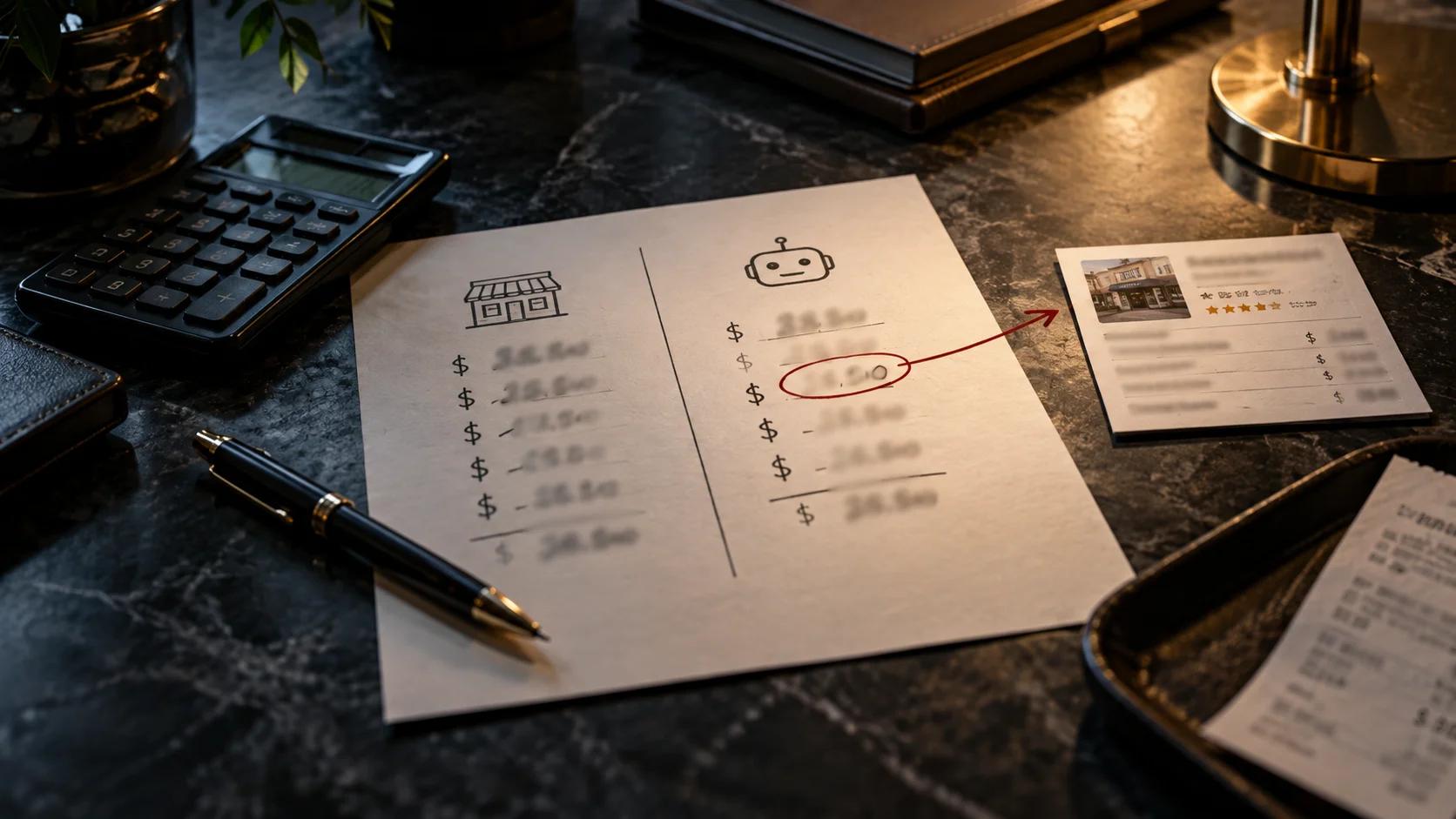

The mechanism that flooded social media with coordinated AI accounts last month is the same mechanism producing your competitor's review page. Understanding it takes about five minutes. Fixing your own profile takes one afternoon.
1. What the coordinated accounts story actually shows
Reuters published an investigation in August 2026 documenting how a network of AI-generated accounts had amplified a consistent position about the AI Security Institute across months of posts. The accounts were not identical. They used different writing styles, different lengths, different platforms. But they all pointed the same direction, and none of them contained verifiable coordinates: no specific event, no dateable interaction, no detail that could only come from direct experience.
The thing that made the accounts detectable was not that they sounded artificial. Most of them didn't. The thing that made them detectable was absence. They agreed with each other without having anything specific to agree about.
What this has to do with your review profile
Running twenty distinct voices about the same product is close to free now. A business owner with a basic AI setup and a weak review count can flood three platforms in an afternoon. And the pattern looks, on the surface, exactly like a business that is genuinely liked by a lot of people.
2. Why "several people agree" stopped working as a signal
Social proof is built on a simple assumption: when multiple independent sources agree, the agreement is evidence. That assumption held when the cost of fabricating an independent source was high. It no longer holds.
The human brain has not updated its priors. We still register three matching reviews as three separate observations. Platforms are catching up, but their detection cycles run behind the models generating the content - usually by six months to a year.
The only check that doesn't age is the one that tests for information the model couldn't have had. A model writing a fake review about a dental office can describe the experience in general terms. It cannot describe the specific hygienist who was running late, or the waiting room renovation that finished in July, or the unexpected conversation that happened on the second visit. Those details require having been there.
3. What this looks like in your reviews
The pattern shows up in two directions.
The outbound category is worth sitting with. A lot of businesses generating fake positive reviews are not trying to deceive anyone in a malicious sense - they're trying to offset unfair negative reviews, or trying to catch up with a competitor who clearly isn't playing by the rules. The problem is that a fake positive review fails the same filter as a fake negative one. It doesn't help you prove anything, and it puts you in a position you can't defend if it's ever examined.
4. The coordinates filter
Three checks. A real review passes at least two of them.
Decision rule: if two of the three are missing, that review contains no information you can use as evidence. Not for you if it's positive, not against you if it's negative.
That framing matters. A negative review that fails the coordinates filter is not proof that something went wrong. It is not proof of anything. You don't need to panic about it, and you don't need to respond as if it represents a real complaint.
5. What to do with the reviews already on your profile
Four situations, four responses.
6. Why a reliable AI detector does not exist for this use case
Detection tools trained on AI-generated content work well for a few months. The models generating content update faster than the detectors. A tool that reliably identified GPT-3 output did not transfer to GPT-4. A tool calibrated on last year's output fails on this month's.
The coordinates filter does not age. It does not test for how the text was written. It tests for whether the information in the text requires having been present. That requirement does not change when the model updates. A more sophisticated model writing a fake review for your dental office is still writing without access to which hygienist was there, when the renovation finished, or what the specific conversation was on the second appointment.
The one thing to do
If you want to run this check with a structured tool, the Review Health Check walks you through it with prompts for each criterion and gives you a profile score at the end.
Two reviews that agree with each other prove nothing. One review that tells you the hygienist's name, the month of the visit, and the specific thing that surprised them is worth more than fifty generic five-star ratings.
Run the filter this week. Your review profile is either evidence or it isn't. The coordinates tell you which.
Keep reading
- The five disciplines map - where reputation fits inside the full framework
- AI doesn't guess, it skips you - why AI recommendations depend on verifiable content
- Google Business Profile and AI recommendations
- Hacking your business now costs $50 - the security side of a compromised online presence
- This week in AI - the Monday roundup that covers the broader picture
Sources
- Reuters investigation into coordinated AI accounts amplifying content about the AI Security Institute, August 2026
- Platform detection lag analysis - industry estimates of 6-12 month gap between model updates and detector updates (multiple sources, 2024-2026)
- GoHighLevel / Reputation Management platform documentation on review flagging and reporting workflows