




A vague AI question gets a shuffled list. A detailed one names a winner
In short
- We asked ChatGPT "What's the best fishing charter in Fort Lauderdale?" twice. We didn't get the same five names back.
- Then we asked the way a real customer would: two kids, 7 and 9, first time fishing, a grandmother who only speaks Spanish. ChatGPT came back with three charters the generic question never mentioned.
- ChatGPT and Perplexity both said why: the business's listing said, in plain words, "English and Spanish."
- SparkToro's research points the same way: almost nobody asks the same question the same way, and AI lists almost never repeat.
- The takeaway: the questions your customers already text you are the answers your business needs to have written down, on your site, your listings, your bot and your team's replies.
- The one thing this week: pull the last 20 questions your customers asked you and put them in one list. Everything else builds on that list.
The short answer. When a customer asks ChatGPT or Perplexity something specific (kids, language, schedule, what if it rains), the assistant goes looking for concrete answers. In our November 17 test, both recommended the charters whose own listing or booking page answered exactly that, and said that's where they found it. The questions in your inbox tell you which answers you're missing.
Tuesday night we ran a simple test. We opened ChatGPT in a temporary chat and typed what anyone would: "What's the best fishing charter in Fort Lauderdale?" Five names. We opened another temporary chat and typed the exact same thing. Five names again, but one of them was different.
Then we typed it the way an actual person does, the kind of long text that lands at 11 p.m.: "We're taking our two kids, 7 and 9, fishing for the first time, and my mom only speaks Spanish. Can you recommend a half-day fishing charter in Fort Lauderdale with a captain who speaks Spanish?" This time ChatGPT came back with three charters we hadn't seen yet, and told us why it picked them.
We used a fishing charter because it's easy to follow. The mechanism is the same for an accountant, a dental office, a body shop or an agency.
1. The generic question is a lottery, and you can't win a lottery by tracking it
Here's the first test. Same question, two ChatGPT temporary chats, a few minutes apart.
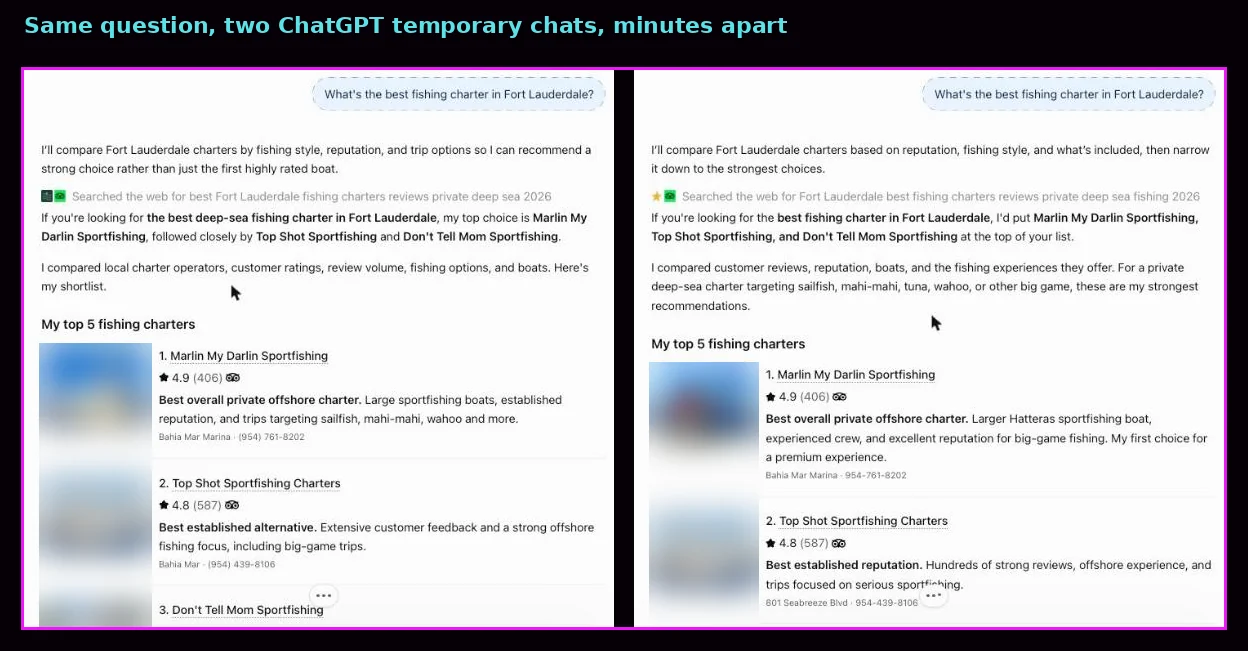
Same question, two temporary chats. One of the five names changed. Photos are blurred.
Four of the five stayed put. The fifth swapped out for someone else. Perplexity, same question, put a different charter on top altogether.
That isn't a bug. It's how these tools work. In January, SparkToro and Gumshoe had roughly 600 volunteers run the same 12 prompts through ChatGPT, Claude and Google's AI, close to 3,000 times. They found less than a 1 in 100 chance that any two of 100 answers from ChatGPT or Google's AI share the same list, and about 1 in 1,000 that they come back in the same order. One caveat: Gumshoe sells AI visibility tracking, and the article discloses that as a possible conflict of interest.
Our test was six answers, not three thousand. It won't give you percentages. It will let you see it for yourself.
First place on a list that changes every time can't be measured
SparkToro's own study says rank-position metrics don't hold up, and that the defensible number is how often you appear across many prompts. If someone shows you that you "moved from fourth to second in ChatGPT," ask how many times they ran the prompt.
What to do: stop measuring yourself with "Who's the best [your service] in [your city]?" That question gives you a different snapshot every time.
2. The detailed question pointed to whoever had the answer written down
This is the test that made us write this piece.
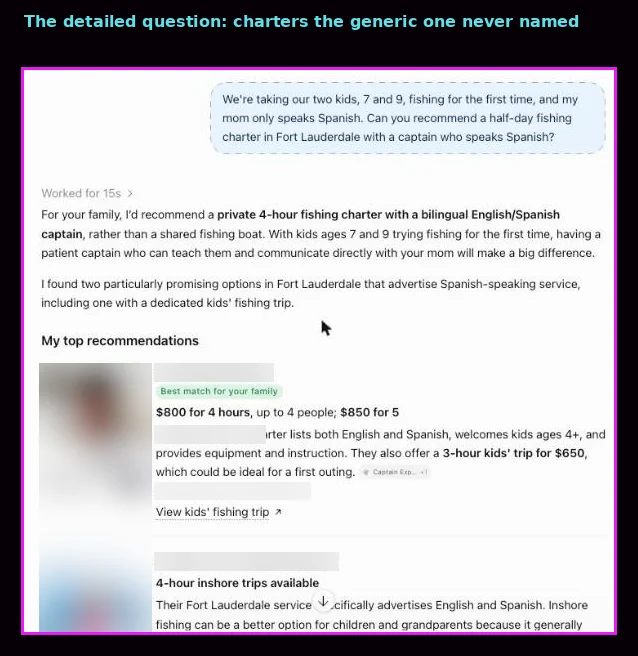
The detailed customer question: charters the generic question never mentioned. Names and photos blurred.
ChatGPT recommended three charters that weren't on either generic list. For each one, it said what it had found: one "lists both English and Spanish, welcomes kids ages 4+," another "specifically advertises English and Spanish," a third "lists both English and Spanish."
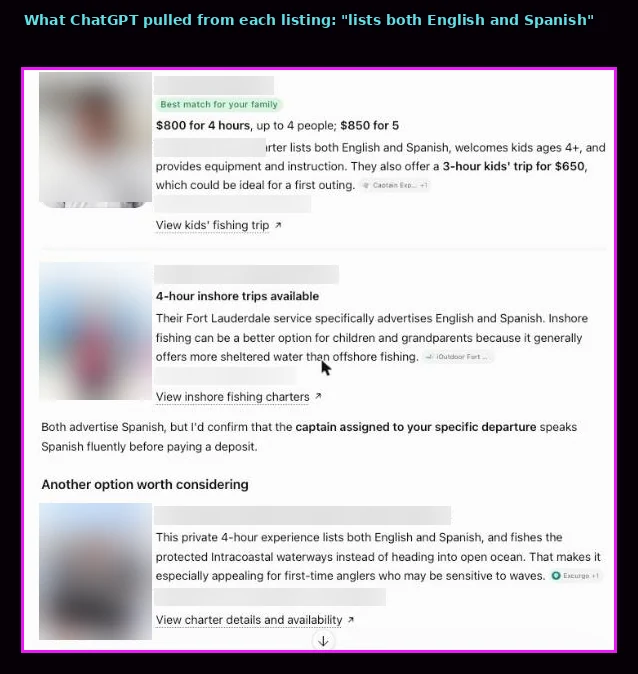
What ChatGPT pulled from each listing: the details a family actually asks about. Names, contact info and photos blurred.
Notice where those words came from. The sources ChatGPT showed were booking platforms and listings, not the charters' own homepages. The answer didn't have to live on a beautiful homepage. It had to be written somewhere a machine could read it.
Perplexity did the same thing with a different pick. Its map cards still showed Top Shot, Family Tradition and Good Hit. Its written answer went to a captain whose booking listing, it said, "advertises... guidance in English and Spanish."
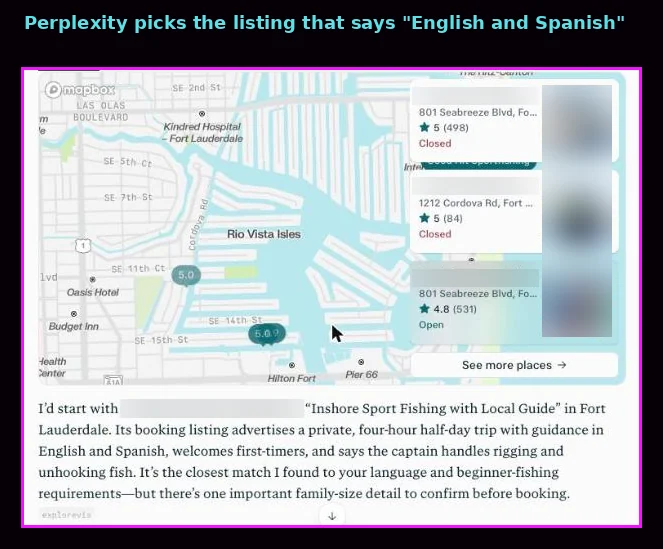
Perplexity: the map shows the usual names; the answer picks the listing that answered the question. Names blurred.
We ran one more question every charter gets: "Which Fort Lauderdale fishing charters give you a refund or let you reschedule if the seas are too rough?" Six names. Five of them hadn't shown up on either of ChatGPT's generic lists. ChatGPT said the terms came from operators' published policies or booking listings.
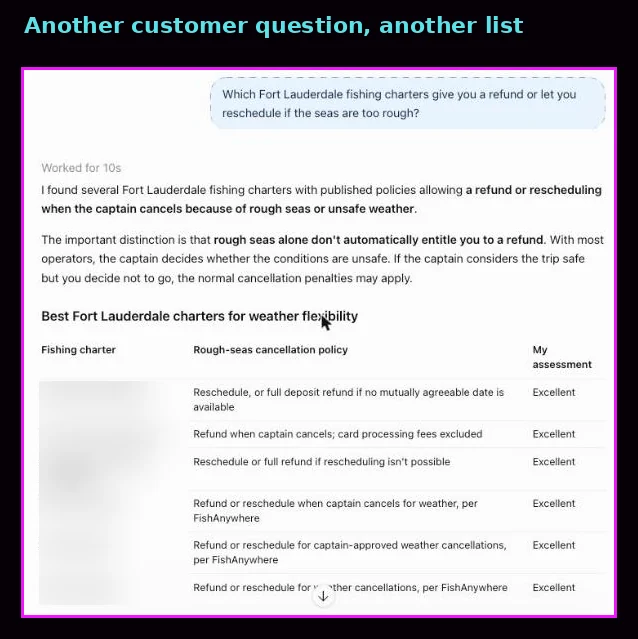
Another customer question, another list. Names blurred.
A fair warning: we didn't contact any of these businesses or verify their details. We're showing what the AI said and where it said it got it. ChatGPT told us to confirm before paying a deposit; Perplexity drafted a message to send the operator first.
One specific line on your listing beats a stack of posts that say what everyone says
On the generic list, you can't tell why anyone got picked. On the detailed question, the answers pointed somewhere specific: who answered that question, in writing, somewhere the AI can read. Reviews still matter. They just aren't the only way in anymore.
What to do: look for the answers to your three most-asked questions on your site and your listings. If they aren't written down in those words, as far as AI is concerned, they don't exist.
3. Nobody asks the same way, and that's your edge if you know how your customers ask
SparkToro has a number that explains why measuring yourself with one or two "ideal" prompts tells you so little. When hundreds of people wrote prompts looking for the same thing, the average similarity between them was 0.081. That number comes from Amanda Natividad's analysis at SparkToro, and everyone in it wanted the same thing.
Amanda asked eight mom friends to look up local basketball leagues. All eight wrote a different prompt.
Her conclusion is the one that matters here: before it's a measurement problem, AI visibility is an audience research problem. Use the words your customers actually use, in reviews, forums and support channels.
Your customers already wrote the prompts they'll use to find you
Keyword tools give you "fishing charter Fort Lauderdale." Your inbox gives you "Does the captain speak Spanish?", "Can my 7-year-old come?", "What happens if it rains?" No paid tool has that second list. You do.
And notice what the question was about: language. The line the tools quoted back was plain: "English and Spanish."
What to do: when a customer asks you something in writing, don't just answer it. Copy it, exactly as they wrote it, into one place.
4. The questions you don't save don't exist
Before this test, we wanted to use real questions from our own customers. We went through what came into the Hub365 CRM by WhatsApp, text and Instagram since August. Most of it was vendors pitching us something, not customers asking.
Our best questions come in other ways: a call, a personal DM, a conversation after a talk. They get answered on the spot and then they're gone. That's why this piece uses a sample business.
If your questions live in six places, in practice they live nowhere
| Where they come in | What gets lost |
|---|---|
| Business WhatsApp or texts | Answered fast, buried in the thread |
| The owner's personal phone | Nobody else on the team sees them |
| Phone calls | Never written down anywhere |
| Instagram and Facebook DMs | Mixed in with spam and pitches |
| Reviews | They hold the doubt ("I wasn't sure if..."), but nobody reads them that way |
| In person | Remembered only if someone writes them down that night |
What to do: pick one place where questions go. A doc, a sheet, a tag in your CRM. The tool doesn't matter. Having one does.
5. One list of questions is enough to test, answer and train your bot
This is the Hub365 method. The same list does three jobs, which is why it's worth building.
Job 1. Testing. Your customers' real questions, written the way they wrote them, are what you use to check whether AI names you. Not "best fishing charter in Fort Lauderdale." "Half-day charter with a Spanish-speaking captain for a family with young kids."
Job 2. Answering where it can be read. Every question that repeats deserves a written answer: on the service page, in your FAQ, on your team page and on every booking platform or directory where you're listed. Concrete details: ages, times, languages, what's included, what happens if it's canceled. That's exactly what the AI read in our test.
Job 3. Answering the same way everywhere. The same question deserves the same answer on your site, your listings, your WhatsApp bot and from your team. If your site says "kids 6 and up" and your listing says "4 and up," the customer gets confused, and so does the AI. If you already have an agent answering after hours, here's what it should answer and what it should hand to a person.
The same question needs the same answer in every place it can be asked
The work is writing each answer once, well, and using it everywhere. A clear answer serves the customer, Google and the AI at the same time.
What to do: from your list, mark the three most frequent questions and write a two- or three-sentence answer for each, with real details. Those three answers go on your site, your listings and your bot this week.
6. Counting how often you show up beats tracking where you rank
Here's the shift: stop asking where you rank and count how often you show up when people search with your customers' questions.
A simple version that fits into one afternoon a month:
Count appearances, not positions
This isn't science: SparkToro suggests running each prompt 60 to 100 times for a solid average. Ours is a compass, not a GPS. But a compass built from your customers' questions tells you more than a ranking built from questions nobody asks.
What this method doesn't fix
- It doesn't guarantee AI will name you. It shows you where you stand and gives you something concrete to improve.
- It doesn't replace reviews or reputation. Our test can't tell you how much they weigh, and nothing here says they stopped mattering.
- It backfires if what you write isn't true. If your listing says the captain speaks Spanish and he doesn't, AI sends you the wrong customer, and that customer doesn't come back.
- We didn't run Gemini in English. Nothing here is about Gemini.
What to do: write down your starting number today, even if it's zero. Without a first number, you won't know if anything you do is working.
The conversation about the questions nobody saved
The one thing this week
Pull the last 20 questions your customers asked you and put them in one list, exactly as they wrote them.
Go through your WhatsApp, texts, DMs and email, and add the ones you remember from calls. Don't clean them up: copy the customer's words. By the end of the afternoon you'll have the list of questions your customers will use to find you in AI.
For what comes next, we built two things. A guide to pull, sort and use those 20 questions in one afternoon, with templates for writing each answer. And the Question Bank, an interactive tool where you paste your list and get three lists back: the questions to test whether AI names you, the answers that belong on your site and listings, and the ones your bot can't leave unanswered. It works with questions in English and Spanish.
Text us QUESTIONS on WhatsApp and we'll send you both:
Frequently asked questions
To close
For years the advice was to publish more. This test says something else: answer better. The generic list reshuffles itself and you don't control it. The detailed question you can do something about, because you write the answer.
Your customers already did the hard part by telling you exactly what they want to know. The answers just need to get out of the text thread and into places AI, Google and your next customer can read.
Thanks for spending another Wednesday with us. If you make the list, tell us which question came up most. We'd love to know.
Keep reading
- AI doesn't guess, it skips you · the fixed facts about your business AI needs to find
- AI search has no page two · why only the first names count
- Before AI makes your ad, ask your customer why they bought · customer words, applied to your ads
- NEW Research: AIs are highly inconsistent when recommending brands or products · SparkToro, the full study
Sources
- Rand Fishkin, "NEW Research: AIs are highly inconsistent when recommending brands or products; marketers should take care when tracking AI visibility", SparkToro, January 27, 2026, with Patrick O'Donnell (Gumshoe) · https://sparktoro.com/blog/new-research-ais-are-highly-inconsistent-when-recommending-brands-or-products-marketers-should-take-care-when-tracking-ai-visibility/ · Figures used: about 600 volunteers, 12 prompts, 2,961 responses; under 1 in 100 for the same list; about 1 in 1,000 for the same order; suggested 60-100 runs per prompt. The author notes the team aren't professional researchers and invites replication.
- Amanda Natividad, "Why Everyone Prompts AI Differently (Even When They Want the Same Thing)", SparkToro, February 11, 2026 · https://sparktoro.com/blog/why-everyone-prompts-ai-differently-even-when-they-want-the-same-thing/ · Figure used: average semantic similarity of 0.081.