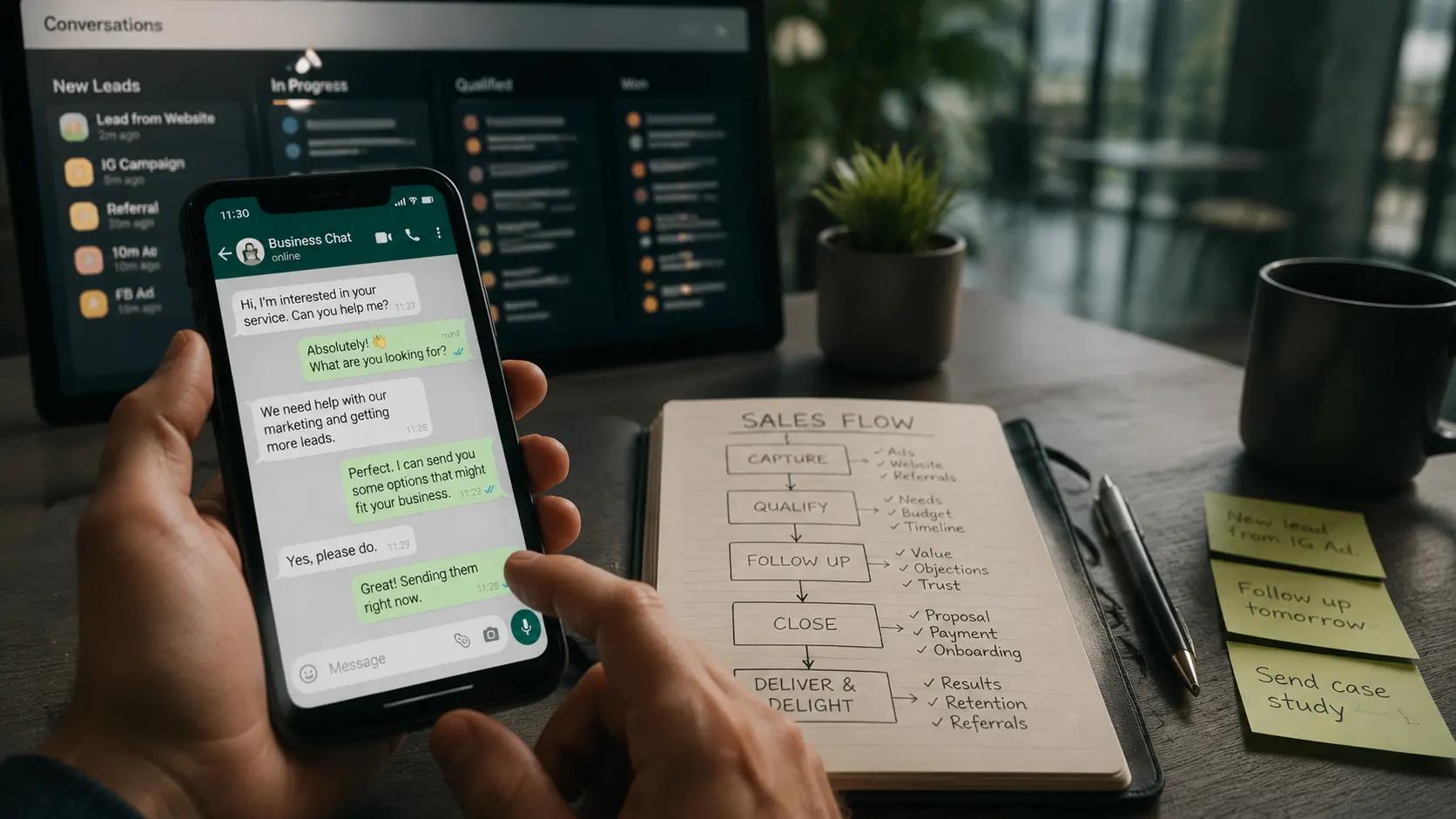

If you run a service business in South Florida and most of your customer conversations happen on WhatsApp, this week's news is the kind that quietly destroys a Saturday: Meta is rolling out Business-Scoped User IDs as the new standard identifier for the WhatsApp Business API, replacing the phone number. Apple, in parallel, shipped end-to-end encrypted RCS to iOS 26.5 beta - finally collapsing iMessage and Android RCS into one encrypted experience that rivals WhatsApp on quality.
Both changes are real. Both have deadlines. Both are infrastructure problems, not marketing problems. And neither should ever land on the desk of someone who runs a tax practice, a paint crew, or a funeral home.
What just happened
Meta is moving every WhatsApp Business API account onto a new identifier format. Instead of +1786..., your business is now something like US.13491208655302741918 - an alphanumeric token scoped to your business inside Meta's directory. The change is already live in Cloud API and Marketing Messages Lite as of May 2026. Phone-number-based identifiers continue to work today, but accounts that haven't migrated before Meta flips enforcement will start seeing messages fail. Vonage's developer documentation is the cleanest current explanation of the migration's scope and the required actions.
Apple's parallel move - encrypted RCS in iOS 26.5 beta with day-one support from AT&T, T-Mobile and Verizon - is quieter but bigger over twelve months. RCS is no longer the green-bubble compromise. By Q3 2026, US clients will expect encrypted messaging at iMessage quality from any business that texts them, and SMS will be the budget tier.
Why it matters for service businesses in South Florida
Your customer doesn't care that a protocol changed. Your customer cares that the confirmation message they got last Thursday arrived, the reschedule reminder this morning arrived, and the invoice link tonight is going to arrive. The exact moment they stop trusting that you'll show up on WhatsApp is the moment they stop booking.
The 600,000+ Hispanic-owned small businesses in Florida are disproportionately exposed here, for a simple reason: bilingual customer bases live on WhatsApp. It is not the secondary channel. It is the channel. A US painter whose Anglo clientele texts on iMessage can survive a quiet week of degraded SMS deliverability. A funeral home in Hialeah whose families coordinate on WhatsApp cannot.
That's the asymmetry behind today's news: the messaging stack is changing in the exact channel where Hispanic SMBs have the least margin for error.
The Hub365 read
We've said for two quarters that the right way to think about messaging isn't "what channel are we on?" It's "is the channel a system we own, or a glued-together stack that will crack the next time a platform updates its API?"
Today's news is the second test of that thesis this year. The first was when Anthropic's API capacity doubled and SMBs realized their lead-response loop still bottlenecked on a Tuesday-morning founder reading a WhatsApp inbox. Today, the bottleneck moves one layer deeper: it isn't even the inbox anymore, it's the identifier the inbox uses to route a reply.
Our position hasn't changed. Wow AI owns the WhatsApp surface. Hub365 CRM owns the contact record. When Meta swaps phone numbers for BSUIDs, our engineering team migrates the field, re-keys the routing, and your inbox doesn't notice. When Apple lights up encrypted RCS out of beta in Q3, we test it as a parallel channel for the segment of your US book that's on iOS 26+ and route accordingly - without asking you to learn what RCS stands for.
A horizontal AI add-on that drops a chat agent inside an existing tool can't do this for you. It lives one layer above the protocol. When the protocol breaks, the add-on breaks with it, and you get an email from your software vendor explaining why your messages didn't send.
That's the whole point of an owned ecosystem versus five subscriptions and a duct-tape script.
What to do this week
If you're already a Hub365 client, the answer is: nothing. We have the BSUID migration on our engineering timeline with a June 30 internal deadline, well ahead of any Meta enforcement window. Your account moves invisibly. If you'd like to be the one client who hears about it before the rest, message us WAREADY on WhatsApp and we'll send a one-paragraph confirmation of where your specific account sits in the queue.
If you're running WhatsApp Business through a different stack - a freelance developer, a generic chatbot add-on, a glued-together flow on n8n, Make or Zapier - here are the three questions to ask whoever runs it for you, this week, in this order:
If they answer #1 with "the what?", that is the answer. If #2 gets a shrug, you will be paying for an emergency project in October. If #3 ends with "in a spreadsheet," you are one platform cutover away from losing the address book.
For new prospects, this is the moment we say it most plainly. The point of having an owned ecosystem - Hub365 CRM, Wow AI, 365 AI Receptionist - instead of five subscriptions held together with hope is precisely so that when Meta or Apple changes the rules, you don't have to read this blog to know whether you're affected.
Do I have to do anything if my business is already on WhatsApp Business API? Yes - your stack has to migrate from phone-number identifiers to BSUIDs before Meta flips enforcement. If your provider hasn't told you they are handling it, ask. If they don't have a date, that's your signal to look at who else does.
Is RCS going to replace WhatsApp for my Hispanic clients? No, not in the next 18 months. WhatsApp adoption among Hispanic households in the US is too entrenched. RCS is a parallel premium channel for your English-speaking US iPhone clients from Q3 onward, not a WhatsApp replacement.
My current vendor is "looking into it." Is that good enough? Not for August. The Meta-side enforcement window typically lands about six months after a GA notice, which puts the meaningful deadline around November. "Looking into it" in May becomes "we missed the window" in October.
Does this affect my Google Business Profile WhatsApp click-to-chat button? Indirectly. That button routes to your WhatsApp Business number, and the number itself still works for inbound chats. The API-side messaging your business sends out - notifications, follow-ups, automations - is what depends on BSUID migration.
Will I be able to send the same kinds of messages I send today after migration? Yes. BSUID changes the identifier, not the message templates. Approved templates and existing opt-ins carry over. The risk is operational (a botched migration breaks deliverability), not content (the messages you send don't change).
Why is Hub365 doing this work before Meta forces anyone to? Because the cost of being early is one engineering sprint. The cost of being late is your client's reschedule notification not arriving on a Friday afternoon, and them calling the next business in their WhatsApp thread.
Sidebar: the pattern under the news
Every six to eight weeks, a platform we don't control changes a rule that determines whether your messages get delivered, your website gets cited by an AI assistant, or your voice agent picks up. Each individual change is small. The cumulative effect, over a year, is a service business that has spent twenty Saturdays on protocol migrations it never wanted to learn about.
The whole point of an integrated stack - one CRM, one messaging layer, one receptionist, one team that operates them - is that the count stays at zero.