Your best client just finished a project with you. The work was excellent. They’re genuinely happy. They would recommend you to their friends if someone asked.
In 48 hours, they’ll be absorbed in their next problem. The experience fades from the front of their mind. If you don’t capture that moment, it’s gone.
This isn’t about manipulation. It’s about a simple truth: the intention to recommend is universal. The action is rare — not because people don’t want to help, but because nobody made it easy at the right moment.
83% of your satisfied clients are willing to leave you a review. Only 29% do. The gap isn’t willingness — it’s friction. This article gives you the complete system: the right moment to ask, the message that generates responses, how to respond to every type of review, and why in 2026 your reviews are also training data for AI recommendation systems. Download the 15 Response Template Kit at the end.
Why Reviews Matter More in 2026
Reviews have always driven local trust. In 2026, they’re doing something additional that most businesses haven’t noticed: AI systems are reading your reviews.
When ChatGPT, Gemini, or Google AI Mode generates a local recommendation, it doesn’t just count stars. It analyzes the language. The words that consistently appear in your review profile become relevance signals.
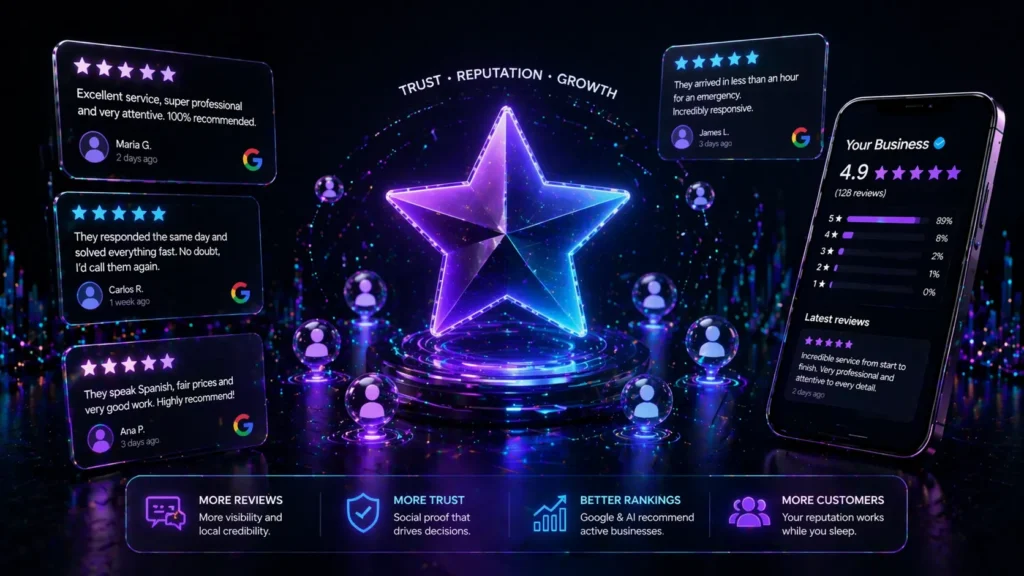
A business whose reviews mention “responds the same day,” “speaks Spanish,” “arrived in under an hour,” and “emergency” will appear in AI recommendations for exactly those searches. A business with 4.8 stars and generic reviews — “excellent service, highly recommended” — provides almost no extractable signal.
This is one of the five GEO signals we covered in the Google Business Profile article. Unlike your profile content, which you control directly, the sentiment of your reviews is built through a system — specifically, by asking the right questions when requesting reviews.
The Numbers That Make This Impossible to Ignore
Todd + Naty — Real Conversation
Naty: The conversation I have most often with clients about reviews isn’t about how to respond to negative ones. It’s this: “We have very happy clients but nobody leaves us reviews.” When I ask how they’re requesting reviews, the answer is almost always: at the bottom of the invoice there’s a line that says “if you liked our service, leave us a review on Google.” That’s not a system. That’s a wish.
Todd: From the data angle, what changed in 2026 is that reviews now do two things in parallel. They convince human clients — that’s always been true. And they feed AI citation algorithms. AI systems analyze the language of your reviews to build relevance vectors. A business whose reviews consistently mention “responds in minutes” or “speaks Spanish” or “handles emergencies” is going to appear in searches containing those terms. A business with generic reviews — “excellent service” — provides no extractable signal.
Naty: And the part I most enjoy explaining: you can ethically shape the language of your reviews without telling anyone what to write. Just by changing the question you ask. Instead of “would you leave me a review?” — “Would you specifically mention how we handled your situation?” The specificity of the request shapes the specificity of the review. And the specific review is the one AI can cite.
Todd: Follow-up is also part of the system — but with one clear rule. One follow-up, then nothing. The client relationship is worth more than the review. What can be automated is the first message — from the CRM follow-up system, configured to trigger 24-48 hours after marking a project as completed. The message stays personal. The timing is automated.
Part 1 — The Review Request System
The Three Moments That Work
Moment 1 — Post-delivery (24-48 hours). The ideal window. Service delivered, happy client, fresh memory. Primary request moment. The 48-hour window doesn’t wait.
Moment 2 — Post-compliment. When a client sends you a positive message — “that turned out great,” “I really appreciate how fast you handled that” — respond to the compliment, then make your request. They’re in active gratitude mode. Conversion at this moment is significantly higher than cold asking.
Moment 3 — Post-milestone (30/60/90 days). For ongoing service relationships, a quarterly check-in with a review request is natural and non-intrusive. It captures a different type of review — about the sustained relationship, not just the initial delivery. This type of review is especially valuable for long-term GEO signals.
The Message That Generates Responses
WhatsApp Template:
“Hi [Name]! So glad we were able to help you with [specific thing]. If you have 60 seconds, would you mind leaving us a review on Google? It genuinely helps other businesses like yours find us. Direct link: [link] — just click and share what you thought. Thank you so much!”
Three things make this work: a specific reference (shows you remember their individual situation), an indirect benefit (“helps businesses like yours” — feels generous, not transactional), and a friction reducer (“just click”).
The Question That Shapes the Review
Instead of “would you leave me a review?” ask: “Would you mention specifically how we handled your situation?”
The specificity of the request shapes the specificity of the review. “You handled my emergency call in under an hour” becomes “they arrived in under an hour for an emergency — incredibly responsive.” That phrase is AI-citable. “Great service” is not.
Questions that generate keyword-rich reviews:
- “Would you specifically mention what you liked about how we handled your problem?”
- “If someone in your industry asked you what made the difference, what would you say?”
- “Would you mention how the specific element of the service worked for your team?”
Follow-Up — One, Then Nothing
If no response in 5 days:
“Hi [Name]! Just making sure my earlier message didn’t get lost. No pressure — here’s the direct link: [link]. Really appreciate it!”
One follow-up. After that, let it go. The relationship is worth more than the review.
Want the 15 Response Templates ready to copy?
Positive, negative, neutral, fake, competitor, no name — 15 EN+ES templates ready to copy and personalize.
Part 2 — The Response System
Why Every Review Needs a Response Within 24 Hours
Three reasons why this isn’t optional in 2026:
Human trust. 89% of consumers say they’re more likely to choose a business that responds to all its reviews (BrightLocal, 2025).
Activity signal for AI. Review responses signal to AI systems that the business is currently operating and engaged. Profiles with recent responses carry higher weighting in citation decisions.
Keyword amplification. When you respond to a positive review and repeat the specific service they mentioned, you add another indexed instance of that phrase to your profile. This compounds your review sentiment signal over time.
Responding to Positive Reviews
Formula: Thank by name + Repeat the specific service they mentioned + Invite them back.
Template:
“Thank you [Name]! We’re so glad that [specific thing they mentioned] made such a difference for your [business/situation]. It was a pleasure working with you — we’ll be here whenever you need us!”
What not to do: “Thanks for your 5-star review! We appreciate your business.” Adds no value and reinforces no keyword.
Responding to Negative Reviews — The 4-Step Formula
Negative reviews handled correctly often do more for your reputation than positive ones — they demonstrate grace under pressure.
Step 1 — Acknowledge. Validate the experience without agreeing with every specific claim.
Step 2 — Empathize. One genuine sentence, not corporate text.
Step 3 — Take it offline. Offer a specific resolution path.
Step 4 — Never argue. Not here, not in public, never.
Negative review template:
“Hi [Name], thank you for sharing this — we’re sorry your experience wasn’t what we aimed to deliver. We’d really like to understand what happened and make it right. Please contact us directly at [email/WhatsApp] so we can review this personally.”
This response shows future prospects exactly what happens when something goes wrong. A prospect who sees this is often more reassured than concerned by the original negative review.
The Fake Review Protocol
1. Respond professionally — same formula as negative reviews. Don’t call it fake in public.
2. Report to Google — “Flag review” in your GBP dashboard. Select the correct category.
3. Document — Keep a record of suspicious reviews with dates and reporting actions.
Never respond with “this is fake.” Even if it’s true, it reads as defensive to everyone who sees it.
Part 3 — The Review Sentiment Strategy
You can’t tell clients what to write. But you can shape what they remember — through the question you ask.
Generic request → generic review: “Would you leave me a review?” → “Great service, highly recommended!” — Not AI-citable.
Specific request → specific review: “Would you mention how our response time worked for your situation?” → “They responded in 5 minutes — I’ve never had a provider that fast.” — AI-citable for searches of “fast response in [city].”
The 15-Minute Monthly Audit
Once a month: review your recent reviews for recurring terms. These are your organic keyword clusters — what your clients naturally use to describe what you do best.
If “fast,” “responsive,” and “same day” appear in 60% of your reviews, you have a cluster. That cluster is now a GEO signal. It’s what AI systems extract when someone searches “[your category] fast in [your city].” To see how this connects to your full profile’s GEO signals, the GBP article covers all five signals in detail.
Naty’s Perspective: What I Tell Clients with Zero New Reviews
To be direct about it. I have clients who come to us with businesses of three or four years, dozens of happy clients who personally recommend them, and 12 reviews on Google. All from 2022. When I ask when they last asked a client for a review, the answer is almost always: “We don’t do that, it feels awkward.”
It feels awkward because they don’t have a system. When you have a system — the right moment, the right message, the right channel — it doesn’t feel awkward. It feels like a natural part of closing a well-executed project.
What we build for them is exactly what’s in this article. An automatic trigger from the CRM that fires the reminder to the team 24 hours after marking a project as completed. The message is sent by the person, not the system — because a personal WhatsApp that mentions the specific project always outperforms an automated campaign. But the timing is automated. And the system ensures it’s never forgotten.
Clients who implement this consistently for 90 days see a real shift — not just in review volume, but in the quality of the language. Specific, citable reviews that describe exactly why they were chosen. Those are the ones that appear in AI responses when someone searches for what they do in their city. To see how this is automated within the complete ecosystem, the CRM article covers the automation layer.
Frequently Asked Questions: The 5-Star Review System
A personal WhatsApp that references the specific project outperforms any automated email campaign. WhatsApp open and response rates are consistently higher. And the personal tone — mentioning something specific about their project — signals that the request is genuine, not mass. Automated "please leave us a review" emails are mentally processed as spam even when they reach the main inbox.
By changing the question you ask. Instead of "would you leave me a review?", ask: "Would you specifically mention how we handled your situation?" The specificity of the request shapes the specificity of the review. You're not telling them what to write — you're helping them remember the specific detail that makes their review useful to others and citable by AI systems.
Respond professionally using the same 4-step formula you'd use with a real negative review — without calling it fake in public. Report to Google using "Flag review" in your GBP dashboard and document the situation with dates and actions. Never respond with "this is fake" — even if it's true, it reads as defensive to everyone who sees it.
AI systems like Gemini, ChatGPT, and Google AI Mode analyze the language of your reviews to build relevance vectors. Terms that consistently appear — "fast," "speaks Spanish," "emergencies," "same day" — become GEO signals. A business with generic reviews provides no extractable signal. A business with specific reviews appears in searches containing exactly those terms.
83% of your satisfied clients are waiting for you to ask for the review.
Download the 15 Response Template Kit EN+ES — ready to copy and personalize for every type of review. Or book a strategy session and we’ll review your current review system together.
Naty Ross is Co-Founder of Hub365.AI, a bilingual digital marketing agency based in Fort Lauderdale, FL, specializing in connected digital ecosystems for local and Latin American businesses.